
5 Wide Receiver Sleepers in the 2026 NFL Draft That Teams Are Quietly Moving Up Their Boards
The names dominating the 2026 wide receiver conversation are familiar by now. Carnell Tate, Omar Cooper, Makai Lemon. Those players have been dissected, debated, and projected into first and second round slots for months. But draft week has a way of surfacing a different kind of story, and this year, five wide receivers from smaller programs and under-the-radar situations are generating the kind of pre-draft noise that typically precedes a run at the podium.
College coaches polled by ESPN this week singled out non-Power 4 wide receivers among their top sleeper picks. PFF updated their receiver rankings with several mid-round prospects shifting upward in the days leading into the draft. NFL.com’s Senior Bowl Day 2 standout coverage has kept specific names circulating loudly in pre-draft meetings. The draft is April 23 and boards are being finalized now, which means the window to understand why these five receivers are climbing is closing fast.
The wide receiver position has historically been one of the most reliable sources of late-round value in the NFL. Speed, separation, and hands translate regardless of conference affiliation, and teams that identify the right small-school wide receivers gaining momentum heading into draft week consistently win the back end of the draft. This class has five names worth understanding before Thursday.
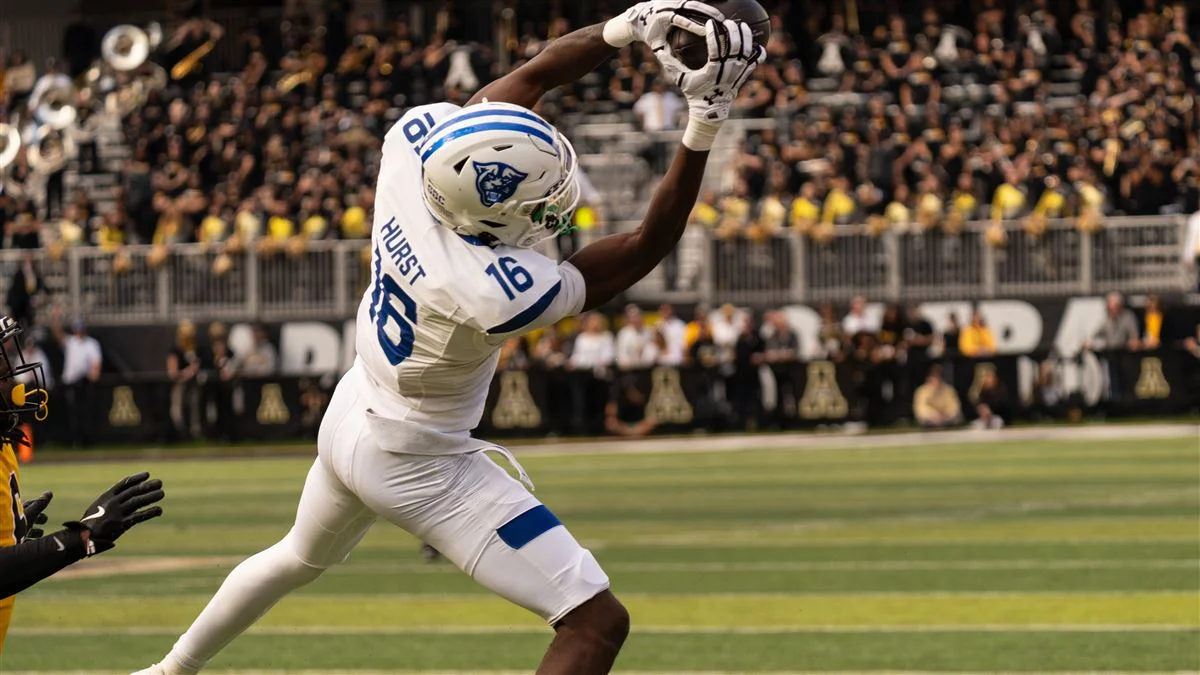
Ted Hurst, WR, Georgia State
Start here. Ted Hurst is the name most fans have not heard yet, which is precisely the point. The Georgia State product stands 6-foot-4 and tested in the 96th percentile for height at his position while posting a broad jump in the 99th percentile and a 4.42 forty. Those are not small-school combine numbers padded by reduced competition. Those are numbers that land on every team’s board regardless of where they originated.
What separates Hurst from a pure athletic profile is the decision behind the production. He had legitimate transfer portal options to bigger programs and stayed at Georgia State. That kind of loyalty to a program tells evaluators something about a player’s character and focus, and in a league where building a roster around reliable, accountable contributors matters, that detail does not go unnoticed in pre-draft meetings.
The Jordan Addison comparison is instructive here. Addison entered the draft as a smaller-school separator with elite athleticism and people wondered whether the competition level was real. Hurst operates from a similar profile but with considerably more size. At 6-4 with a 99th percentile explosion score and sub-4.45 speed, the physical argument is not a question. The question is scheme fit and development timeline, and for a Day 3 investment, that is an extremely manageable risk.
Bryce Lance, WR, North Dakota State
North Dakota State has a documented history of producing NFL contributors, and Bryce Lance fits cleanly into that pipeline. Back-to-back 1,000-yard seasons at the FCS level are noteworthy on their own, but the detail that has scouts leaning in is his deep ball production. Lance ranked second in the nation with a 76 percent catch rate on deep targets in 2025 and fifth nationally in catches of 20-plus air yards. That is not volume padding. That is precision on the most difficult throws in football.
Deep threat wide receivers with catch rates like that are rare at any level. The concern with small-school deep threats typically centers on whether the separation was generated against inferior corners who will not exist in the NFL. Lance’s technique on stem routes and his ability to track the ball at its highest point suggest the production is translatable. He profiles as a vertical weapon who can stress safeties on day one and grow into a larger role as the route tree expands.
Among the 2026 NFL Draft small school wide receivers gaining the most traction this week, Lance sits at the top of most short lists alongside Hurst. Teams running outside zone concepts that need a legitimate home-run threat on third and long have every reason to be looking at Lance in the fourth round conversation.
Tyren Montgomery, WR, John Carroll
The Tyren Montgomery story requires some context. He was a walk-on basketball player at LSU before finding his way to John Carroll, which is a Division III program in Ohio. The biography reads like a feel-good feature until you watch the Senior Bowl tape, where Montgomery made a highlight catch over a San Diego State cornerback that triggered an immediate recalibration from scouts in attendance.
Small school wide receivers who earn Senior Bowl invitations and then perform against Power conference defensive backs are making a statement that production numbers alone cannot make. Montgomery made that statement. The athleticism that made him a basketball prospect translates directly to football in terms of body control, hand-eye coordination, and the ability to adjust to imperfect throws. Those traits do not come from a playbook. They are either present or they are not, and Montgomery has them.
The development arc is longer here than with Hurst or Lance. But teams drafting in the sixth or seventh round are not looking for immediate starters. They are looking for traits worth developing, and Montgomery’s basketball background combined with his Senior Bowl performance is exactly the kind of profile that earns a roster spot and a legitimate offseason evaluation.
Germie Bernard, WR, Notre Dame
Germie Bernard carries a different kind of intrigue than the others on this list. He is not a small-school story and he is not a pure athleticism projection. Bernard is a separation receiver from Notre Dame who some evaluators have projected as a mid-second to early-third round value, which would make him not a sleeper in the traditional sense but arguably the most undervalued player in the entire 2026 wide receiver class relative to the buzz he has generated.
The headline trait is what he does after the catch. Bernard’s ability to create yardage in contested space after the reception separates him from pure route runners who disappear on contact. Versatile separation receivers who can function in the slot, split out wide, and contribute as a YAC weapon are exactly what modern offenses are building around. Bernard fits that profile with a Power conference pedigree that removes the competition level question entirely.
If Bernard slides to Day 3 because teams prioritize other positions early, someone is getting a significant steal. He is the player on this list most likely to outperform his draft position in years two and three.
Jakobi Lane, WR, USC
Jakobi Lane’s situation is straightforward and slightly unfair. He played at USC behind Makai Lemon, who is generating legitimate first-round buzz heading into the draft. When you line up next to a player with that kind of profile, your production and visibility suffer regardless of your individual ability. Lane has spent two years being overlooked for precisely that reason.
At 6-4 with the kind of physical upside that makes teams stop the tape, Lane profiles as a deep threat who has not been given the volume to demonstrate what he can do as a primary option. The 2026 NFL Draft late round wide receiver pool does not have many players offering this combination of size and raw vertical ability. Lane is a pure upside investment, the kind of player a team drafts in the fifth round and evaluates for 12 months before deciding whether his ceiling is real.
The Addison parallel resurfaces here in a different way. Addison left USC and thrived when he became the focal point of an offense. Lane has not had that opportunity. Some evaluators believe the opportunity is the missing variable, and at his size and speed, the argument is hard to dismiss.
Why These Five Names Matter Before Thursday
Hurst, Lance, Montgomery, Bernard, and Lane represent different versions of the same draft-week reality. The 2026 NFL Draft wide receiver sleepers conversation is not just noise generated by content cycles. It reflects a genuine shift in how pre-draft meetings are evaluating the back half of receiver boards as the combine data settles and film reviews conclude.
Ted Hurst’s 99th percentile explosion score does not care about conference affiliation. Bryce Lance’s deep ball catch rate does not diminish because it came from the FCS. Tyren Montgomery’s Senior Bowl performance happened in front of every scout in the building. Germie Bernard’s after-catch ability is on tape from a Power conference program. Jakobi Lane’s physical profile exists independent of who lined up next to him.
The wide receiver position consistently rewards teams willing to look past the obvious names and trust the traits. Thursday is coming fast. These five are worth remembering before it does. Stay Tunes to Our 2026 NFL Draft HUb