
Jeff Caldwell NFL Draft Sleeper Watch: How One Combine Performance Rewrote the Board
A few months ago, Jeff Caldwell was an afterthought. A big receiver from Cincinnati with an FCS background, limited Power 5 tape, and a route tree that needed serious work. The consensus landing spot was somewhere between the final rounds and an undrafted free agent deal. Then Indianapolis happened. One combine performance later, Caldwell is now a legitimate Day 3 target, a name surfacing in scout rooms, and the kind of prospect that forces front offices into a genuine philosophical debate. That shift — from UDFA risk to early Day 3 upside bet — is the story worth understanding before April 23.
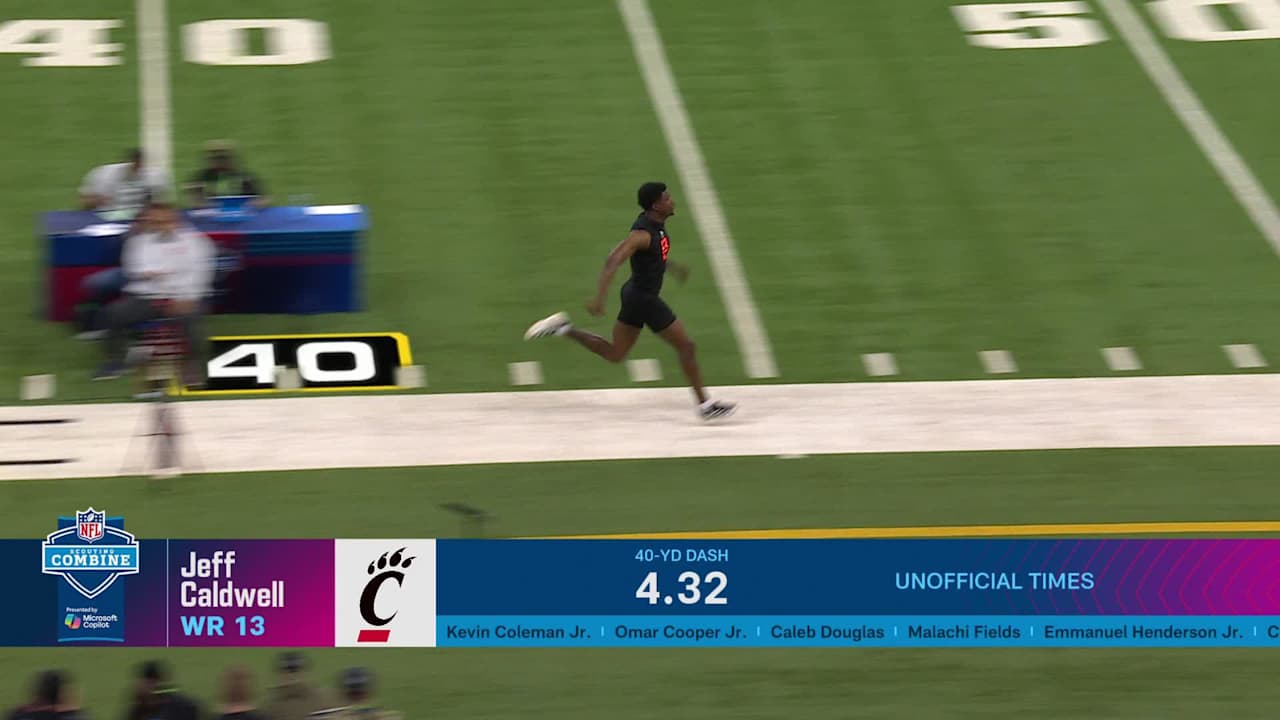
The Jeff Caldwell Combine Changed Everything
The numbers Caldwell posted in Indianapolis were not good. They were historic. A 4.31 forty — second fastest among all wide receivers — attached to a 6-foot-5, 216-pound frame that made him the tallest wideout at the entire event. Add a 42-inch vertical, a second-best mark among receivers, and an 11-foot-2 broad jump, and the profile that emerged was something evaluators simply do not see very often. Steve Smith, breaking down the workout footage, called it one of the best combine performances he had ever seen. That is not hyperbole designed to generate clicks. That is a former NFL receiver watching a testing profile that checked every box a team could want from a size-speed archetype.
For context, top-two receiver testing in both the Jeff Caldwell 40 time vertical at that size has not come around often since records have been tracked. That rarity is exactly what moved his combine results from a footnote into a genuine draft conversation.
Why the Measurables Actually Matter Here
Athletic testing only changes evaluations when the traits translate to a real NFL role. With Caldwell, the translation is obvious. At 6-foot-5 with elite speed and a massive catch radius, the red zone becomes a different equation. Coverage defenders who can match his length typically cannot match his speed. Corners who can run with him struggle to locate the ball over the top of him. As a vertical threat or a back-shoulder red zone target, the physical tools are not just impressive in the abstract — they map directly onto one of the most valuable and difficult-to-fill positions in modern offense.
The comparison that keeps surfacing is Alec Pierce, the former Cincinnati receiver who carved out an NFL role on exactly this kind of profile. That precedent matters. Pierce was not a finished product coming out of Cincinnati either. He was a traits investment that paid off. Caldwell’s production path is different — one Power 5 season after back-to-back dominant years at FCS Lindenwood, where he averaged 19.5 yards per reception, scored 11 touchdowns, and was a Walter Payton Award finalist — but the archetype is the same. The question is whether teams trust the developmental track.
The Real Debate: Traits Investment vs. Technical Risk
This is where teams are genuinely split. The AFC director of college scouting quoted by ESPN put it plainly: “You don’t see many guys with that kind of length who run like that. He needs work… but the traits are there.” That framing captures the exact tension driving Caldwell’s volatile stock. On one side, a route tree that needs significant polish, documented issues attacking the ball in traffic, and a body of work that leans heavily on one FCS season and a complementary role behind Cyrus Allen at Jeff Caldwell Cincinnati in 2025. On the other, a physical profile rare enough that passing on it entirely feels like a mistake.
The concern case is legitimate. Raw routes at the NFL level get exposed quickly. A receiver who cannot create separation against man coverage and cannot win contested catches consistently becomes a liability, regardless of what he ran in shorts in February. Caldwell’s 32 catches and 478 yards at Cincinnati last season were solid for a secondary option, but they did not answer the deeper questions about his technical readiness. His Jeff Caldwell scouting report still carries real red flags that no forty time eradicates.
The upside case is equally legitimate. Coaching can fix routes. It cannot manufacture a 4.31 on a 6-foot-5 body. That combination does not get created in a film room, and it does not show up in this draft at any other position on the board. For teams willing to invest developmental patience, the ceiling here is genuine.
What This Forces Teams to Decide
The draft range Caldwell now occupies — Rounds 4 through 6, with volatility in both directions — puts the decision squarely on offensive coaching staffs and front office philosophies. Teams running spread concepts with young quarterbacks who need a vertical safety valve and a red-zone weapon have obvious motivation. The modern NFL has proven repeatedly that one elite trait, properly schemed, can generate massive value. A receiver who threatens the deep middle, stresses safety rotations, and requires a double team near the goal line does not need to be a finished route runner to be worth a fourth or fifth-round pick.
Teams prioritizing NFL-ready technical receivers, however, will wait. Some will wait until the sixth round. Some will pass entirely and revisit the conversation as a priority UDFA. Given how volatile this stock remains, both outcomes are realistic depending on pre-draft visits and positional board construction heading into draft week.
Where Caldwell Lands and What Happens Next
The consensus sits at No. 152 on Mock Draft Database, No. 146 per Scouts Inc., and No. 181 on PFF’s big board — a range that reflects exactly the split in how evaluators are processing his profile. Early Day 3 is the current floor if the Jeff Caldwell combine results 2026 buzz holds through pre-draft visits. A slide to late Day 3 or undrafted is still on the table if teams collectively decide the technical concerns outweigh the physical gifts. That kind of range variance this close to the draft typically means pre-draft visits are doing real work in one direction or the other.
Watch for reported visits from offense-heavy teams with developing quarterbacks. That is the signal that Caldwell’s board position is about to move again. As a sleeper in the Jeff Caldwell NFL Draft conversation, the infrastructure is there — historic testing, a recognizable developmental template, and growing momentum from credible voices inside the league. Whether that momentum translates into a call on Day 3 or a free agent signing on Day 4 likely comes down to which organization decides it wants to own the upside rather than wait for someone else to prove it first.
The traits are real. The risk is real. In the late rounds, that is exactly the kind of bet worth making. Stay tuned 2026 NFL Draft Hub