
Joel Klatt’s Top 50 Big Board: The Prospects Creating Real First-Round Debate
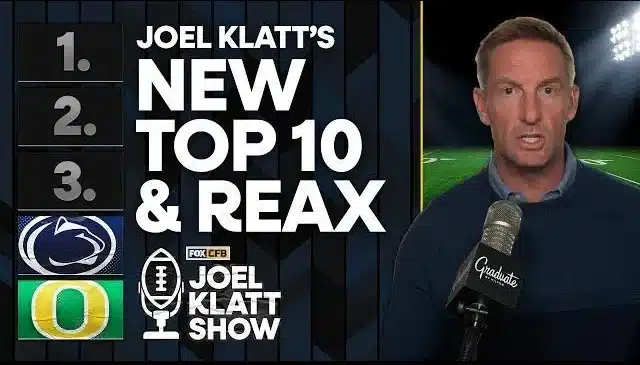
Joel Klatt just released his top 50 NFL Draft big board — and the most interesting story isn’t who’s at the top. It’s the players where reasonable evaluators are going to split hard, where first-round range debates are genuine, and where the gap between traits and production is forcing real decisions. Klatt’s board is built around a clear philosophy: production on tape wins over raw athleticism, but elite traits still force teams to reach. The tension between those two ideas defines the most debated prospects on this list — and none more so than running back Jeremiah Love, who Klatt has at number two overall.
Jeremiah Love at Number Two: The Positional Value Debate Teams Can’t Avoid
Klatt is not hedging on Jeremiah Love. He has the Notre Dame running back ranked second on his entire big board, projects him to go no later than sixth overall, and calls the Titans an ideal landing spot. That is a direct challenge to the conventional draft wisdom that running backs simply don’t belong in the top five.
The case Klatt is making isn’t sentimental. Love runs between the tackles for big plays, beats defenses outside, catches out of the backfield, and holds up in short-yardage situations. That three-down profile is what separates him from every other back in this class. For teams that believe offensive weapons at that position can elevate a quarterback — Klatt specifically names Cam Ward and Tennessee — passing on Love in the top five starts to look like a mistake driven by positional bias rather than actual evaluation.
The counterargument is real: running back value in the NFL has been systematically compressed, and most front offices aren’t ready to break from that structure regardless of the talent. If Love falls past pick six, it won’t be because teams don’t see it. It’ll be because they’ve decided the position still isn’t worth it. That’s the live debate surrounding him right now.
Sunny Styles and the Ohio State Defensive Surge: Three Buckeyes Inside the Top Five
Klatt has three Ohio State defenders in his top five — Sunny Styles at five, Caleb Downs at four, and Arlell Reese at three — and the combine performance is what pushed Styles in particular past where most boards had him before Indianapolis. A 6’5, 245-pound linebacker who ran a 4.46 with a 43.5-inch vertical isn’t a projection. That’s a finished physical profile attached to a player who captained the Buckeyes’ defense and lined up at safety before transitioning down to linebacker.
Styles is being viewed as a near-perfect fit for how modern defenses are built — someone who can blitz, cover out of the backfield, and anchor a linebacking unit for a decade. The risk isn’t athletic. It’s whether the production at Ohio State translates cleanly to NFL schematic demands. Klatt isn’t worried about it. He sees Styles as the type of player who should not get past pick ten.
Reese sits at three with a different kind of ceiling. One year as a starter, used both as an off-ball linebacker and as a pass rusher off the edge, Reese is the highest-upside defender on Klatt’s board. He’s not there because of what he’s done — he’s there because of how high the floor is on what he could become. That combination of one-year starter production and elite athleticism is precisely what creates wide draft ranges. Teams who trust projection will reach. Teams who want proven tape will wait.
The Traits-vs-Production Split: Caleb Banks, Keldrick Faulk, and the Edge Debate
Klatt draws a sharp line between prospects he’s valuing on tape and prospects he’s valuing on traits — and nowhere is that split cleaner than at edge rusher. Caleb Banks at 27 and Keldrick Faulk at 26 both land in the first-round range purely because their physical profiles are hard to dismiss. Banks is 6’6 and 327 pounds with 35-inch arms and a wingspan over eight feet. Faulk is only 20 years old with a build and athleticism that projects well beyond what Auburn’s program allowed him to produce.
But Klatt is direct about the gap: neither has matched their physical ceiling with consistent on-field production yet. That’s the risk teams are navigating. For every evaluator willing to draft the upside, there’s another who won’t invest first-round capital in a profile that hasn’t proven itself under competitive SEC conditions. Faulk in particular may be undervalued given his age — 20-year-old edge rushers with his athletic markers don’t grow on trees — but Auburn’s instability over the past few years created real context around his numbers.
The contrast is Cashes How from Texas A&M, who checks in at 25 without elite measurables simply because he was unblockable on tape. Klatt’s argument is straightforward: production on film is the real signal, and How delivered it consistently. Teams who agree will take How earlier than traits-first evaluators expect.
Fernando Mendoza at Number One: The Quarterback Klatt Believes In Most
Klatt’s top overall player is Fernando Mendoza, the Indiana quarterback who checks every box Klatt prioritizes at the position: 6’5, 225 pounds, accurate on intermediate and deep throws outside the numbers, and consistently at his best in high-pressure road environments. The wins against Iowa, Oregon, and Penn State on the road aren’t cherry-picked moments — they’re the pattern Klatt is building his evaluation around.
The trait Klatt weights most heavily is leverage on downfield throws — specifically whether the quarterback’s delivery gives his receiver a better chance at the ball than the defender. Mendoza’s film answers that question clearly. For scouts who have been concerned about Indiana’s level of competition, the road performance against top-tier defenses is the direct rebuttal. This isn’t a system quarterback who inflated numbers against weak opponents. Mendoza made the biggest throws in the biggest moments of the Hoosiers’ season.
Whether NFL decision-makers land in the same place is the live debate heading into draft weekend. Klatt is comfortable being out in front of it.
The most compelling takeaways from Klatt’s top 50 aren’t the consensus names — they’re the players where his board creates genuine tension with conventional draft thinking. Love’s positional value debate, Reese’s projection-based ranking, and Mendoza’s hold on the number one spot are the fault lines worth watching as final boards get locked in. For more NFL Draft analysis and content, stay tuned to 2026 NFL Draft Hub.